Diana’s Brother REVEALS SHOCKING Truth About Meghan Markle! Royal Experts FURIOUS Over Comments!
“So, Charles Spencer, the man who has basically been a ghost for 30 years, finally said something and the way he did it is honestly more fascinating than if he’d held a press conference.”
He didn’t issue a statement. He didn’t sit down for a primetime special. What he did was receive a proposal, a very specific, very ambitious proposal from the Sussex camp, and then he just said no.
Flat, unambiguous, door closed, no. And that single word from a man defined by his absolute refusal to engage with any of this landed in the royal world like a thunderclap. Within days, royal experts were dissecting what it meant because this wasn’t simply a documentary deal falling through.

This was the last blood guardian of Diana’s memory drawing a line publicly and unmistakably between what his sister’s legacy truly was and what it was being turned into. To understand what Charles Spencer did with that proposal, you first have to understand what kind of man was holding it. Most people who know the name Charles Spencer know exactly one moment, September 6th, 1997, Westminster Abbey.



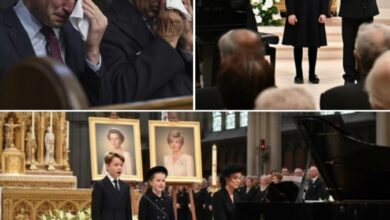
A global television audience of roughly 2 billion people, a young man at a lectern, his voice controlled but his eyes carrying something raw, something that had no business being restrained. And then the words came. He spoke about his sister as a very British girl. He spoke about her laughter, her naturalness, the genuine quality of her compassion.
Then he made the promise, the one that echoed out through the nave, pulled applause in from the streets outside, and stopped every person in that building cold. He promised that Diana’s sons would be shielded from the cold, dysfunctional machinery that had chewed their mother apart. He promised that her blood family, the Spencers, would never allow the institution to swallow them the way it had swallowed her.
He said it directly from that lectern to the Queen’s face, to Prince Philip’s face, to the future king sitting just a few feet away, he didn’t flinch once, and then he walked back to Althorp and for the most part disappeared. That long, deliberate, almost eerie invisibility is exactly what gives his recent actions such extraordinary weight.
We live in a media culture built entirely around Diana’s image. Her face appears on magazine covers, on stamps, on memorial merchandise, on streaming thumbnails. She is one of the most commercially reproduced figures in the history of celebrity. And through all of it, Charles Spencer has never once opened the vault, never sold the archive, never given the interview that cracks even an inch of it open, never licensed the grounds at Althorp for anything beyond what he felt was appropriate.
The world has had decades to wonder what is in that archive. Handwritten diaries, home movies, privately taken photographs from her childhood, from ordinary family days that were never meant to be extraordinary. The raw, unguarded Diana, the one that exists in no documentary, no biography, no Netflix series, that woman is still private.
She survives only because one man kept saying no. What makes that discipline genuinely remarkable and genuinely rare is that the financial incentives to do the opposite have never been small. The offers, by all accounts, have been consistent, lavish, and presented by people skilled at making compromise feel like wisdom.
Publishers, broadcasters, streaming giants with nine-figure content budgets, and teams of producers who specialise in making the unthinkable feel reasonable. The pitch is always some version of the same thing.
“The world deserves to know her properly. You can control how it’s done. You can shape the narrative. Better you than someone who gets it wrong.”
And Charles Spencer, for 30 years, has responded to every version of that argument with the same answer. He does not need the money. He does not need the profile. And he does not believe the world’s desire to consume Diana is the same thing as the world’s right to consume her.
That is a distinction almost no one else in this story has been willing to make, and it is the distinction that defines everything he has done since that day at the Abbey. So, the real question, the question royal experts have been sitting with, is what was in that proposal that made him say no so loudly that the world heard it. And who sent it?
It began the way so many things in this family begin, with something small, beautiful, and apparently innocent. The royal wedding, May 2018, the evening reception, Meghan Markle arrived wearing Diana’s aquamarine ring. That distinctive pale blue stone, recognisable to anyone who had ever followed Diana’s story, from where Charles Spencer sat watching, it likely felt tender. Someone new, someone his nephew clearly adored, choosing to carry Diana into the biggest night of her life.
It felt like remembrance. It may even have felt like family. But then came the butterfly earrings, then the Cartier watch, then the gold bracelets. Piece by piece, item by item, each belonging that had once been Diana’s surfaced on Meghan at precisely the moments where a photograph was not just likely, but absolutely guaranteed.
Major public events, choreographed arrivals, maximum lens coverage. Now, this needs to be said clearly, no one can prove the intention was anything other than genuine tribute. Grief is complicated, and Meghan had married into one of the most emotionally complex families in history. Wearing your late mother-in-law’s jewellery is not evidence of strategy.
It is, on its own, a perfectly human thing to do. But sit with the harder question: when does tribute become a pattern? When does pattern start to look like a deliberate choice? Once is tribute, twice is habit. Every single time, at precisely the moments designed for maximum camera coverage, starts to look like something else entirely.
And the man at Althorp was paying attention. He was cataloging every frame, because these items were not just jewellery, they were pieces of Diana’s story. And they were being placed in someone else’s narrative without a single conversation with the person who holds the originals. It is worth pausing on what those items actually represent in the context of Charles Spencer’s guardianship.
Diana’s jewellery was not simply personal property passed to Harry, it was and remains in the minds of those closest to her, a physical extension of the woman herself. These were objects she chose, touched, wore on her most significant days. They carry a kind of biographical weight that transcends their material value. And when they begin appearing in a carefully managed visual campaign, styled for photo shoots, timed to announcements placed against Californian life for maximum warmth and impact, the person watching from Althorp is not seeing grief, he is seeing inventory.
He is seeing someone else’s assets being converted into someone else’s brand without so much as a phone call to the estate. Keep that thought, because the jewellery was only the opening act.
March 2021, the Oprah interview, the entire planet watched it. But picture it the way Charles Spencer reportedly watched it, from the same house where Diana grew up, from the rooms where he and his sister ran as children.
The setting was golden and intimate, low light, soft furnishings, the architecture of confession rather than confrontation. One woman, one sympathetic interviewer, one institution that had, she said, silenced her, dismissed her suffering, and left her isolated with nowhere to turn except directly to the public.
If you know your royal history, the recognition hits you immediately because that is almost beam for beam the structure of Diana’s 1995 Panorama interview. Here is why that matters so profoundly. A royal wife isolated inside the institution speaking of a palace apparatus that was deaf to her pain. Every internal door closed.
So, she goes over its head straight to the nation through a single trusted interviewer. The lighting rhymes, the casting rhymes, the grammar of victimhood rhymes, the setting, the tone, the emotional arc, all of it rhymes except for one critical difference. And it is the most telling detail in the entire comparison.
Diana gave her 1995 interview while she was still trapped, still inside the system, no exit in sight, no resources beyond what the institution allowed, everything to lose. That interview was a genuine cry from inside a locked room. The 2021 version was filmed from a villa in California after the exit with a production apparatus already in motion, a streaming empire already in development, a brand already taking shape.
The original was distress, the remake, whatever else you believe about it, was a launch. And watching it from the Althorp sitting room, Charles Spencer did not experience that hour as tribute. But to understand why it cut him so deeply, why it crossed the line that the jewellery had only approached, you have to know a secret about this man, one that most mainstream royal coverage never touches.
By long-standing, well-documented accounts, it was Charles Spencer himself who first brought his sister into contact with Martin Bashir, the journalist behind the 1995 Panorama interview. He believed he was doing something helpful. He had been shown documents, bank statements, as far as he knew, evidence that people close to Diana were secretly being paid to spy on her, that she was surrounded by informants, that those she trusted most were being financially rewarded to betray her.
He opened the door, and we now know, through a formal inquiry led by Lord Dyson, a former Supreme Court Justice, exactly how those documents were obtained. They were forgeries. Fabricated from scratch, fake bank statements designed to convince a frightened isolated woman that everyone around her was an enemy, that her only safe move was to sit in front of a camera and bleed for the nation.
Diana’s vulnerability in that interview was not a side effect of the broadcast. Her vulnerability was the product. The manufactured distress was the point. And her younger brother, deceived by the same fake documents, had unknowingly held the door open. The inquiry found that the forgeries had induced him into arranging the meeting.
The BBC’s Director-General issued a personal apology to him directly. Think about what that does to a person. You spend your entire adult life believing you are your sister’s protector. You stand in Westminster Abbey and tell 2 billion people that you will shield her sons. You carry that vow as a defining act of your life, and then decades later you discover that the single most psychologically damaging media event of her existence, the interview that exposed her innermost pain to a global audience that consumed it like entertainment, walked in through a door you were tricked into opening.
By every account, everything Charles Spencer has done since is an act of quiet, relentless atonement. The sealed archive, the year-after-year refusals, the decision to bury Diana on the island at Althorp rather than surrender her to any institution, the home movies that no one outside the family has seen, the handwritten diaries that no one outside the family has read.
He has been making absolutely certain that nothing like Panorama can ever happen to Diana again. Not in life, she is gone, not in death, not now, not ever. And in doing that, he achieved something almost no famous figure in the modern era has managed. He protected her mystery. There is a real Diana, unguarded, fully human, private, that the world never got to consume.
She survives only because one man kept saying no, even as the whole world kept asking. The weight of that achievement is generally difficult to overstate. In an era where every private correspondence eventually surfaces, where estates are monetised by executors, where children sell their parents’ letters and siblings sell their siblings’ secrets, Charles Spencer has maintained a cordon of privacy around his sister that has held for nearly three decades.
Biographers have tried, broadcasters have tried, publishers with very large chequebooks have tried. The answer is always the same. You would not find a comparable archive, this carefully protected, this long undisturbed, belonging to anyone of Diana’s cultural magnitude anywhere in the world. She is, in a meaningful sense, the most famous person of her generation whose inner life remains genuinely unknown.
And that is not an accident, that is a brother’s work. So picture him sitting in his chair when a courier arrives with a proposal that wants all of it. Let me lay out what that proposal reportedly contained, because once you hear it in full, his response stops looking like aristocratic stubbornness and starts looking like the only rational answer a man in his position could possibly give.
The concept was a grand anniversary documentary for 2027 marking 30 years since Paris, emotional, cinematic, intended to be definitive, fronted by Diana’s own son, on paper it sounds extraordinary. The project the world has been waiting for. And by these accounts, Netflix responded to the idea with immediate enthusiasm.
But here is what it reportedly required. It wanted Althorp itself, the childhood home, the grounds, the island where Charles Spencer buried his sister, the private island in the lake that she specifically chose because it was beyond the reach of cameras and crowds and institutions. It wanted the private family archives.
Not the photographs that have already circulated, not the footage already in the public domain. The real archive, the one no one has seen. It reportedly wanted Diana’s personal handwritten diaries, pages written only for herself, pages she never intended anyone outside her most trusted circle to read. It wanted the home movies, the unguarded Diana, the private Diana, the laughing ordinary human Diana that no documentary has ever touched.
Without those, the documentary would be another recycled collection of footage that every Diana documentary since 1998 has already used. With them, it would be something entirely different. It would be the definitive portrait of the century. And then there was one more element, the one that made the pitch magnetic to the people selling it and utterly unthinkable to the man reading it.
The documentary reportedly wanted to draw a direct explicit line between Diana’s war with the institution and Meghan’s. It wanted to position Meghan Markle as the modern continuation of Diana’s story, the 21st century version of the woman who refused to be silenced. Diana’s halo formally transferred on camera with Diana’s own family’s blessing.
Think about what Charles Spencer saw when he read that. He had watched the jewellery emerge piece by piece, each item timed to a guaranteed lens. He had watched the Oprah interview, the Panorama architecture rebuilt panel by panel with California sunlight replacing the BBC studio.
He had watched the documentary series in which a couple fleeing the press framed themselves as hunted by the same machinery that had destroyed Diana without a single phone call to Althorp before filming began. And now they wanted the originals, the diaries, the home movies, the island, the halo fitted to a new head. According to the reporting, he shut it down completely, refused any access to the archive.
And here is the detail that royal watchers keep returning to. He did not call a press conference, he gave no interview, he released no statement, he did not say a word to a camera, he simply closed the door and in closing it made his position unmistakable to everyone paying attention. For a man who had guarded that silence for 30 years, the refusal itself was the loudest thing he had ever said outside Westminster Abbey.
Within days, according to recent reporting, royal commentators were framing the refusal in terms far beyond a failed business negotiation. Some called it a verdict. Here is why that framing matters. Consider the architecture of power in this story. Prince William has reportedly been privately unhappy for years about the way his mother’s image has been commercialised.
He watched the streaming series, he watched the Oprah interview, he has eyes. But look at his position. He is the future king. Every move he makes carries institutional consequence. He cannot publicly block his own brother’s projects without manufacturing a headline about palace censorship and a family at war. The moment the institution intervenes, it reads as the establishment protecting itself.
The same establishment Diana spent her life fighting. When the palace blocks something, it is the machine defending the machine. But when Diana’s own brother refuses, the man who in that Abbey, who made that vow, who has blood ties to both princes and no office to protect, that is something completely different. That is family honour, and nobody in the Sussex communications apparatus can spin it.
There is only one person in this entire story with standing credibility, blood connection to Diana, and absolutely nothing to gain from saying no. No palace role, no institutional loyalty, no public image to protect, no book to sell. The one person who could draw this line without it being weaponised against the crown was the one person who never needed to speak to anyone.
And royal watchers noticed. Some reportedly framed it as the most significant act by anyone connected to Diana in years. Not because of what it revealed, but because of what it refused to reveal. Others called it a quiet act of war. What no one called it, and this is the telling detail, was a surprise.
The people who track Charles Spencer’s movements will understand the architecture of his silence, who have followed the 30-year pattern of refusals, not one of them expressed shock. The surprise, if there was any, was that the proposal was made at all, that anyone in Montecito, with even basic research available to them, looked at this man’s 30-year record and concluded that this time would be different.
That grief, or blood, or the weight of a Netflix contract would open what every publisher, every broadcaster, every documentary maker had failed to open. That said something, perhaps the most revealing thing of all, about the state of judgement inside the Sussex operation at the moment the courier was dispatched.
Either way, the man who never speaks had finally been heard. To understand why that documentary mattered so desperately, you have to look at where Harry and Meghan’s media empire actually stood heading into 2026. It is not a flattering picture. The lifestyle series with love, Meghan, the flagship project that was supposed to consolidate her brand and establish her as a cultural voice in her own right, became the iceberg it was meant to avoid.
The Times gave it two stars and described it in a phrase that has become something of an epitaph as “surely dull”. The Telegraph also landed on two stars characterising it as an “exercise in narcissism padded with extravagant brunches and branding exercises.” And then came the Guardian, a publication that had long been sympathetic to Meghan, no friend to the monarchy, the outlet most predisposed to give the series a generous reading.
It awarded a single star. Netflix’s own internal rankings for the back half of 2025 reportedly placed the series at number 1,217. When the entire spectrum of press coverage from the sympathetic left to the sceptical right converges on the same verdict, that is not a review problem, that is a product problem. And here is the single detail that sharpens that picture most sharply.
The couple’s debut documentary, the one about their royal exit, their relationship, their decision to step back, remains one of the most watched debuts in Netflix’s history. Everything produced since has met steadily cooler responses. The message from the numbers could not be clearer.
The world is not buying Meghan’s lifestyle brand. The world is buying royal wounds. The only Sussex product that has ever truly sold is proximity to the crown and proximity to Diana. With the Spotify deal long gone, the American Riviera Orchard Ventures stalling, Netflix having walked away from the as ever brand, the documentary was never a passion project, it was a rescue flare, and the man at Althorp let it burn out without touching it.
Strip the emotion out for a moment and look at this purely as a question of assets. When Harry and Meghan stepped back from their working royal roles and moved to California, they had to build a commercial life from what they held. What they held was significant, fame, profile, and access to a story that the world could not stop consuming.
But the most valuable asset, the one that sat at the centre of every product, every pitch, every streaming concept, was Diana, her image, her mythology, her martyrdom. In business terms, the Sussex operation has been trading on a brand without a license because the actual license holder, the keeper of the archive, the owner of the originals, the man with blood authority over how Diana’s private self is used, is a 62-year-old man in Northamptonshire, whom, according to available reporting, nobody in Montecito appears to have consulted before making any of these decisions.
Watch the ledger accumulate, the aquamarine ring, warmly received, widely covered, the earrings, the watch, the gold bracelets, each to a guaranteed camera, the Oprah interview, the Panorama architecture rebuilt panel by panel with California sunlight replacing the BBC studio.
2022 onwards, the streaming series Diana’s tragedy converted into their origin story, her death reframed as the wound that created their justification. And finally, 2026, the request for the vault itself, the diaries, the home movies, the island, the halo transferred. They began by borrowing her jewellery, they ended by asking for her soul.
Each withdrawal larger than the last, each one made without a word to the man who holds the account. And the final withdrawal, the biggest of all, bounced. Now, let us look at where things actually stand because the royal family’s internal landscape is important context here.
By recent accounts, there may be some appetite, cautious, fragile, extremely limited, for a partial thaw with Harry. A degree of private communication, a tentative acknowledgement that the relationship is not entirely beyond repair, but that appetite reportedly extends almost nowhere where Meghan is concerned.
And sources close to the family have reportedly been consistent about why, reducing it to a single word, trust. There is none. The family’s deepest stated concern is reportedly not Meghan’s criticism of them, not her anger, not her public characterisation of the institution. It is her content calendar.
The worry that any private conversation, any dinner, any honest exchange, any moment of genuine family connection becomes raw material, filed, packaged, decisioned, and shipped as the next streaming product. That is the real inheritance of this saga. Not a documentary, not a deal, not a refusal, but two brothers who cannot find a road back to each other, and a family watching from behind a gate at Althorp that stays locked.
The gate will stay locked because the man who holds the key has decided, with perfect consistency, what his job is. His job is not to be an obstacle. His job is not to be anti-Sussex. His job, the job he assigned himself in Westminster Abbey, in front of 2 billion people in September of 1997, is to protect Diana. And protecting Diana in 2026 means protecting what is left of the Diana that the world has never consumed.
There are those who argue that position has calcified into something more than protection, that it has become, over the years, a kind of possession, that no man, however principled, however motivated by love and guilt in equal measure, has the moral authority to determine in perpetuity what another person’s memory is worth and to whom it may be shown.
That Diana herself was a woman who chose, repeatedly and at great personal cost, to speak, to be seen, to go on record, and that a legacy maintained entirely through silence and locked gates may honour the archive without honouring the woman. It is not a comfortable argument, but it is not a dishonest one, and it deserves space in this conversation precisely because the most honest tribute to a complicated person is to resist the urge to simplify them even in the act of protecting them.
And now we arrive at the hardest part, the part where you have to hold two things in your mind at the same time. On one side, there are those who fully support what Charles Spencer did. Diana’s story has been told and retold and streamed and serialised and turned into a content pipeline for three decades. Another documentary, particularly one designed to crown a successor and serve as a commercial platform, would cheapen rather than honour the weight of her actual death.
The 30th anniversary of her passing should be private reflection, not a premiere with a marketing plan. And no one, not even her son, has the right to reach into someone else’s private archive to build their own brand. But then there is the other side, and it deserves a genuinely honest hearing. Harry was her child.
He walked beside her through hospital wards and homeless shelters when he was small enough that she had to hold his hand to steady him. He lost her at 15 on a Sunday morning in a Paris tunnel in front of the entire world. He lived the aftermath inside the very institution his uncle had warned about from that lectern.
No documentary, no archive, no curator, however principled, can take from him what it actually felt like to be Diana’s son. His claim to her story is not borrowed, it is not unlicensed. It is cellular, it belongs to him in a way it will never belong to Netflix or a production company or a streaming algorithm. Both positions are true simultaneously.
Both of them hurt. So stand in each pair of shoes before you decide. You are William. The most painful event of your childhood, the loss that altered the entire shape of your life, is scheduled as a content drop with a premiere date by your own brother’s production partners. The grief you have spent 30 years managing privately is being packaged for a global audience without your consent.
And there is nothing you can do about it that does not make the headline worse. Now, you are Harry. The story of your own mother, the woman who pulled you by the hand through places that were designed to show you what your privilege was actually for, is being treated as property that belongs to gatekeepers and institutions rather than to the boy who was there.
The boy who lost her, the man who still carries her. Both positions are human, both have legitimate weight, and if you are searching for a villain in this story, it does not live in Althorp, it does not live in Montecito, it does not live in Kensington Palace. It lives in the apparatus that looks at a dead woman’s handwritten diaries and calculates their streaming value.
It lives in the machinery that wraps itself around grief and converts it into quarterly targets and launch windows and brand extensions. That is where the problem lives. Not with the son who wants to tell his story. Not with the uncle who refuses to open the vault. With the industry that turns both of their pain into product and calls it tribute.
So, here is the question I want you to carry out of this video. Is it ever right to spend Diana’s legacy as currency, even by her own son? Did Charles Spencer do the only thing a man in his position could do? Or does Harry’s grief give him a claim that no gatekeeper, however principled, however motivated by love, has the right to override? There is no clean answer, and anyone who gives you one quickly is not sitting with the full weight of the question.
What we know is this, a man who has said nothing for nearly 30 years finally said something. Not in words, but in an interview or a memoir or a press conference, in a refusal delivered privately, silently, and precisely because of that silence, heard more clearly than almost anything else that has happened in this saga.
The next chapter belongs to a Sussex operation that is now running low on options and low on credibility with the one person whose cooperation would have changed everything. What it does next, how it repositions, what it reaches for, how it tells its story without the originals, is a story that is still being written.
A story with no obvious ending and no guaranteed audience waiting at the other end of it. And when it moves, we will be here to talk about it.