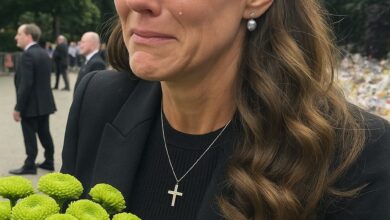
Royals in Shock! Charles FINALLY Honors Diana’s 45-Year Marriage Legacy — Nation MOVED After Speech
Buckingham Palace has quietly confirmed something it avoided for nearly three decades.
For the first time, King Charles is preparing to speak publicly about the marriage that reshaped the modern monarchy and about the woman at the heart of it.
Sources briefed on the plans say the king will reflect openly on Diana, Princess of Wales, and on the partnership that began 45 years ago.
This is not a routine anniversary note passed quietly to the press.
Palace aides describe it as the first time Charles intends to address in his own words how much of his reign rests on foundations Diana laid.

The remarks have not yet been delivered, but the fact that they are coming at all has already sent a quiet shock through royal circles.
Here is what we know.
This is not just a personal tribute to a late princess.
It touches a question the palace has never answered out loud: who actually built the accessible, human, modern monarchy that Charles now presides over? For years, the official story kept Diana inside a single frame—the tragic princess, the people’s icon, a chapter that closed in 1997.

What is now emerging suggests something the establishment has always found harder to say: that Diana was not only adored by the public, she was, in the words of one royal insider, a quiet co-author of the institution’s survival.
Not a decoration on the monarchy, but part of its load-bearing structure.
To understand why this moment matters, it helps to trace the wedding in 1981 that broke centuries of protocol, the humanitarian work that redefined what a royal was even allowed to be, the leaked plan for Charles’s reflection, why palace strategists believe now is the moment to make it, and how Prince William has quietly been carrying the same blueprint into a new generation without ever naming it out loud.
Each thread leads back to the same woman, and each one complicates the story the palace has told for years.
On the 29th of July, 1981, an estimated 750 million people across the world watched a 19-year-old kindergarten assistant marry the heir to the British throne at St.
Paul’s Cathedral.
It remains one of the most watched broadcasts in history.
“I pronounce that they be man and wife together in the name of the Father and of the Son and of the Holy Ghost.
Amen.”
The ceremony was billed as a fairy tale, and for one morning the country believed it.
But the detail that mattered most was not the dress or the crowd.
It was a small act of independence at the altar.
ana omitted the traditional promise to obey her husband, a break that made headlines at the time and signalled even then that she intended to define the role on her own terms.
She was the first Englishwoman in three centuries to marry a future king, and she arrived with an instinct the palace had no manual for: warmth as strategy.
Almost overnight, the expectations placed on a royal shifted.
It was no longer enough to be seen; the public now wanted to be met.
What Diana did next changed the monarchy permanently.
She treated public duty as something personal rather than ceremonial.
She sat on hospital beds.
She crouched to a child’s height.
She looked people in the eye.
In April 1987, at the Middlesex Hospital in London, she opened the country’s first purpose-built unit for AIDS patients and shook the hand of a dying man without wearing gloves.
At the time, much of the public still believed the virus could spread through ordinary touch.
That single unguarded gesture did more to change perception in Britain than any government campaign of the decade.
Consider what that meant in practice.
In 1989, on a visit to a hospital in Indonesia, she sat among leprosy patients and touched them with bare hands at a time when the illness still carried centuries of stigma.
She became patron of Centrepoint, the charity for homeless young people, and she brought her sons along so they would see the work for themselves.
According to the Daily Mail, aides at the time privately worried these appearances were too raw, too close, too unlike anything the palace had done before.
That discomfort was precisely the point.
Diana had grasped something the institution took years to accept: a monarchy that only appeared on balconies would slowly lose the country, while a monarchy that showed up at bedsides might keep it.
“HIV does not make people dangerous to know.
So, you can shake their hands and give them a hug.”
ana omitted the traditional promise to obey her husband, a break that made headlines at the time and signalled even then that she intended to define the role on her own terms.
She was the first Englishwoman in three centuries to marry a future king, and she arrived with an instinct the palace had no manual for: warmth as strategy.
Almost overnight, the expectations placed on a royal shifted.
It was no longer enough to be seen; the public now wanted to be met.
What Diana did next changed the monarchy permanently.
She treated public duty as something personal rather than ceremonial.
She sat on hospital beds.
She crouched to a child’s height.
She looked people in the eye.
In April 1987, at the Middlesex Hospital in London, she opened the country’s first purpose-built unit for AIDS patients and shook the hand of a dying man without wearing gloves.
At the time, much of the public still believed the virus could spread through ordinary touch.
That single unguarded gesture did more to change perception in Britain than any government campaign of the decade.
Consider what that meant in practice.
In 1989, on a visit to a hospital in Indonesia, she sat among leprosy patients and touched them with bare hands at a time when the illness still carried centuries of stigma.
She became patron of Centrepoint, the charity for homeless young people, and she brought her sons along so they would see the work for themselves.
According to the Daily Mail, aides at the time privately worried these appearances were too raw, too close, too unlike anything the palace had done before.
That discomfort was precisely the point.
Diana had grasped something the institution took years to accept: a monarchy that only appeared on balconies would slowly lose the country, while a monarchy that showed up at bedsides might keep it.
“HIV does not make people dangerous to know.
So, you can shake their hands and give them a hug.”
Palace sources are careful to frame this as continuity rather than correction.
The King is not expected to criticise how the establishment once resisted his former wife.
He is expected to acknowledge, plainly, that reforms now treated as his own began with her.
But the reflection, reportedly, goes further.
While the palace has always been careful never to overstate any single influence, sources indicate Charles will connect Diana’s 1987 decision to touch an AIDS patient directly to how the family engages the public today.
That same protocol shift—the willingness to be physically present with suffering rather than symbolically above it—is precisely the logic Prince William now applies to mental health.
In 2016, he launched the Heads Together campaign alongside Catherine to move mental health from the margins to the centre of royal work.
And he has spoken candidly about how losing his mother at 15 shaped the man he became.
When William talks openly about grief, therapy, and psychological struggle, he is not inventing a new royal language; he is extending one his mother wrote first.
What was once seen as Diana breaking the rules is now, in effect, the rule book.
And then, there is the detail royal watchers find most striking.
Insiders told Hello! that the tribute was not solely the King’s own idea.
Sources suggest Prince William privately curated much of it, weaving his father’s stewardship of the crown together with his mother’s original humanitarianism.
In doing so, William reportedly positions Diana not as a tragic footnote to Charles’s story, but as a philosophical co-architect of the very monarchy the family now runs.
That is a remarkable thing for a future king to arrange.
It quietly rewrites who gets the credit.
It also carries a risk the palace is clearly willing to take.
By raising Diana to co-architect, the family invites every old comparison back into the room: the affection she commanded, the crowds she drew, the way she could make the institution look stiff simply by being herself.

There is real complexity here, and it should not be smoothed over.
The marriage at the centre of this tribute was, by both parties’ own accounts, an unhappy one.
“It is announced from Buckingham Palace that with regret, the Prince and Princess of Wales have decided to separate.”